Body Measurement Chart
Accurate body measurements are the starting point for sewing clothes that fit, buying the right size online and tracking fitness progress. This printable pack includes measurement charts for women, men and children, a clear guide to where and how to measure each point, standard clothing size references and an Excel tracker that charts your measurements over time.
Body Measurement Chart Pack
Printable women’s, men’s and kids’ body measurement charts, a measuring guide, a sewing pattern size comparison worksheet, a clothing size reference and an Excel measurement progress tracker.
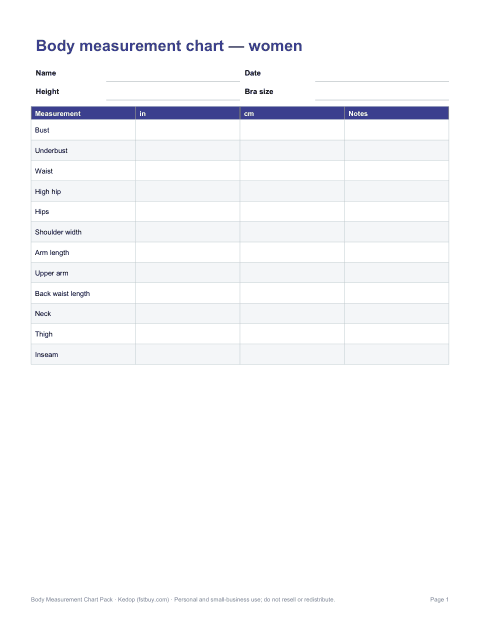
- Women’s chart (PDF/DOCX)
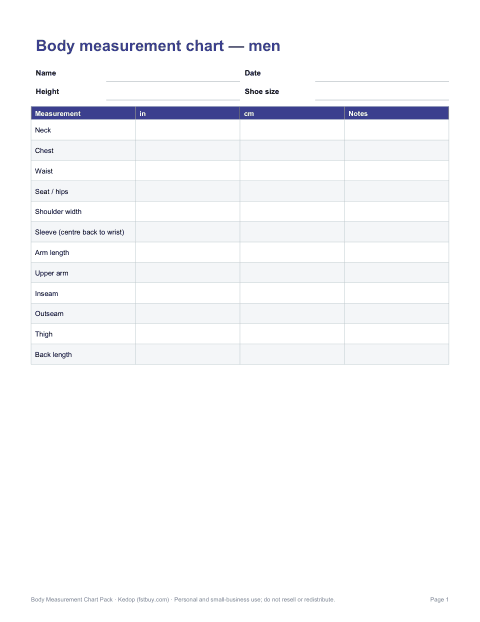
- Men’s chart (PDF/DOCX)
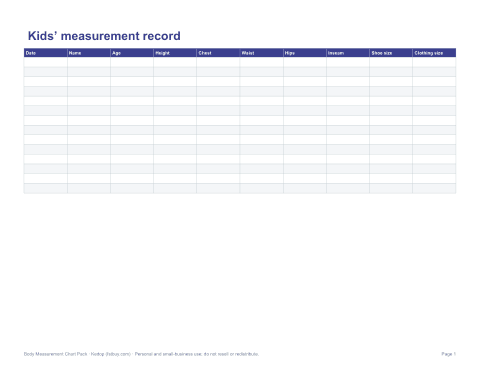
- Kids’ chart (PDF)
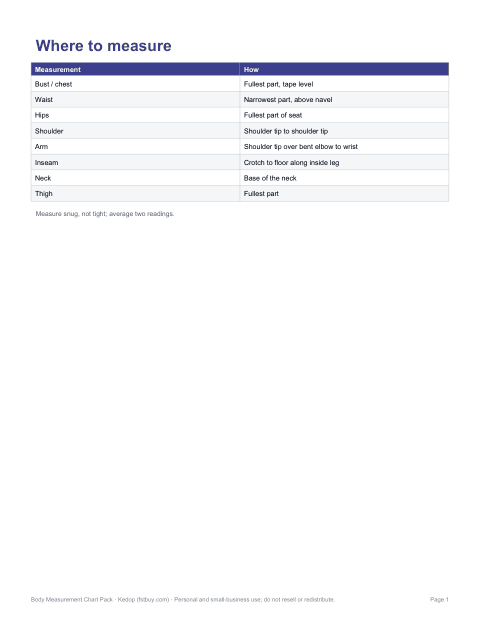
- Measuring guide (PDF)
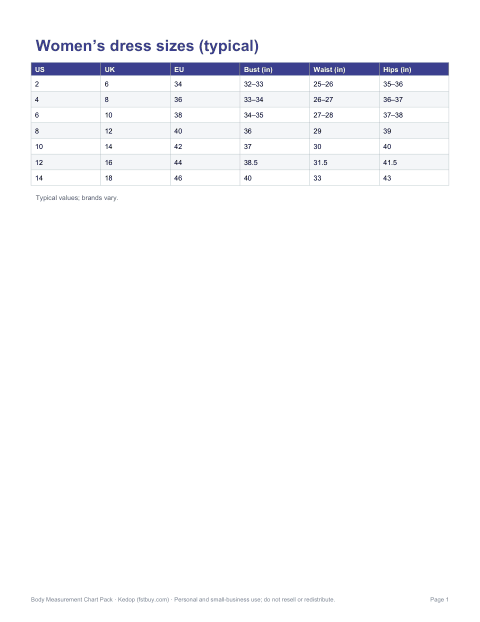
- Size reference (PDF)
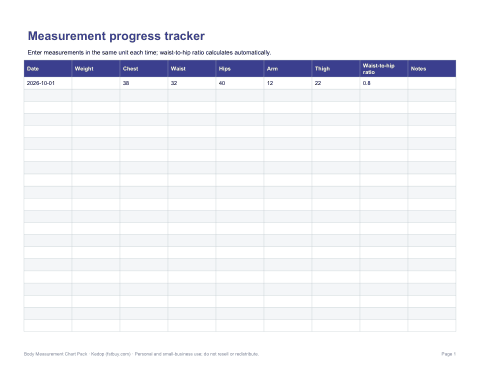
- Progress tracker (XLSX)
Formats: PDF, DOCX, XLSX. Instant download after payment (link valid 72 hours, up to 5 downloads). AI-assisted: the templates were drafted with AI help and reviewed and laid out by Kedop.
$5.00 USD, one-time
Secure card checkout by Stripe. Full refund within 7 days — see the refund policy and license.
Key measurements and how to take them
| Measurement | Where to measure |
|---|---|
| Bust / chest | Around the fullest part of the chest, under the arms, tape level across the back |
| Underbust | Directly under the bust, around the ribcage |
| Waist | Natural waist — the narrowest part of the torso, usually just above the navel |
| High hip | About 4 in (10 cm) below the waist, over the hip bones |
| Hips | Around the fullest part of the seat, feet together |
| Shoulder width | From the tip of one shoulder bone to the other across the back |
| Arm length | Shoulder tip, over a slightly bent elbow, to the wrist bone |
| Upper arm | Around the fullest part of the upper arm |
| Inseam | Crotch to floor (or ankle) along the inside leg |
| Thigh | Around the fullest part of the thigh |
| Neck | Around the base of the neck |
| Back waist length | From the prominent neck bone to the natural waist |
Tips for accurate measuring
- Measure over underwear or close-fitting clothes, not over thick layers.
- Stand straight and relaxed, breathing normally.
- Keep the tape snug but not tight — you should be able to slide a finger under it.
- Keep the tape level all the way round (use a mirror or a helper).
- Measure twice and use the average.
- Tie a piece of elastic around your natural waist to find it and keep it marked.
Using measurements for sewing
Sewing patterns use body measurements, not ready-to-wear sizes, and pattern sizes often run larger than shop sizes. Compare your bust, waist and hip measurements with the pattern envelope’s chart, choose the size that matches the most important area for the garment (bust for tops and dresses, hips for skirts and trousers), and grade between sizes where needed. Record finished garment measurements too, which show the ease the designer added.
Using measurements for online shopping
Clothing size labels vary by brand and country. When buying online, compare your measurements with each brand’s size chart rather than relying on your usual size, and check whether the chart lists body or garment measurements. Keep your measurement card on your phone for quick reference.
Tracking fitness progress
Body measurements can show changes that the scale misses — for example, losing fat while gaining muscle. Measure at the same time of day (mornings are most consistent), in the same spots, every two to four weeks. The Excel tracker records waist, hips, chest, arms and thighs and charts the trend, and calculates waist-to-hip ratio automatically.
Children’s measurements
Children’s clothing is usually sized by age or height, but chest, waist, hip and height measurements give a better fit, especially for uniforms and school clothes. Record measurements at the start of each season to see growth and plan hand-me-downs.
What is in the pack
- Women’s, men’s and kids’ body measurement charts (fill-in).
- Illustrated-style measuring guide with the twelve key points.
- Sewing pattern size comparison worksheet.
- Standard clothing size reference (US, UK, EU).
- Excel measurement progress tracker with waist-to-hip ratio.
Formats
Print-ready PDF charts (US Letter; A4 with “Fit to page”), editable Word measurement cards and an Excel tracker.
Frequently asked questions
Where is my natural waist?
The narrowest part of your torso, usually just above the navel; bend to the side and the crease marks it.
Should I measure over clothes?
Measure over underwear or thin, close-fitting clothes.
How often should I measure for fitness?
Every two to four weeks, at the same time of day.
Why are pattern sizes different from shop sizes?
Sewing patterns use standard body measurements that often run larger than ready-to-wear labels.
Was AI used to create the charts?
The charts were generated by script and text drafted with AI assistance, then reviewed by Kedop.